
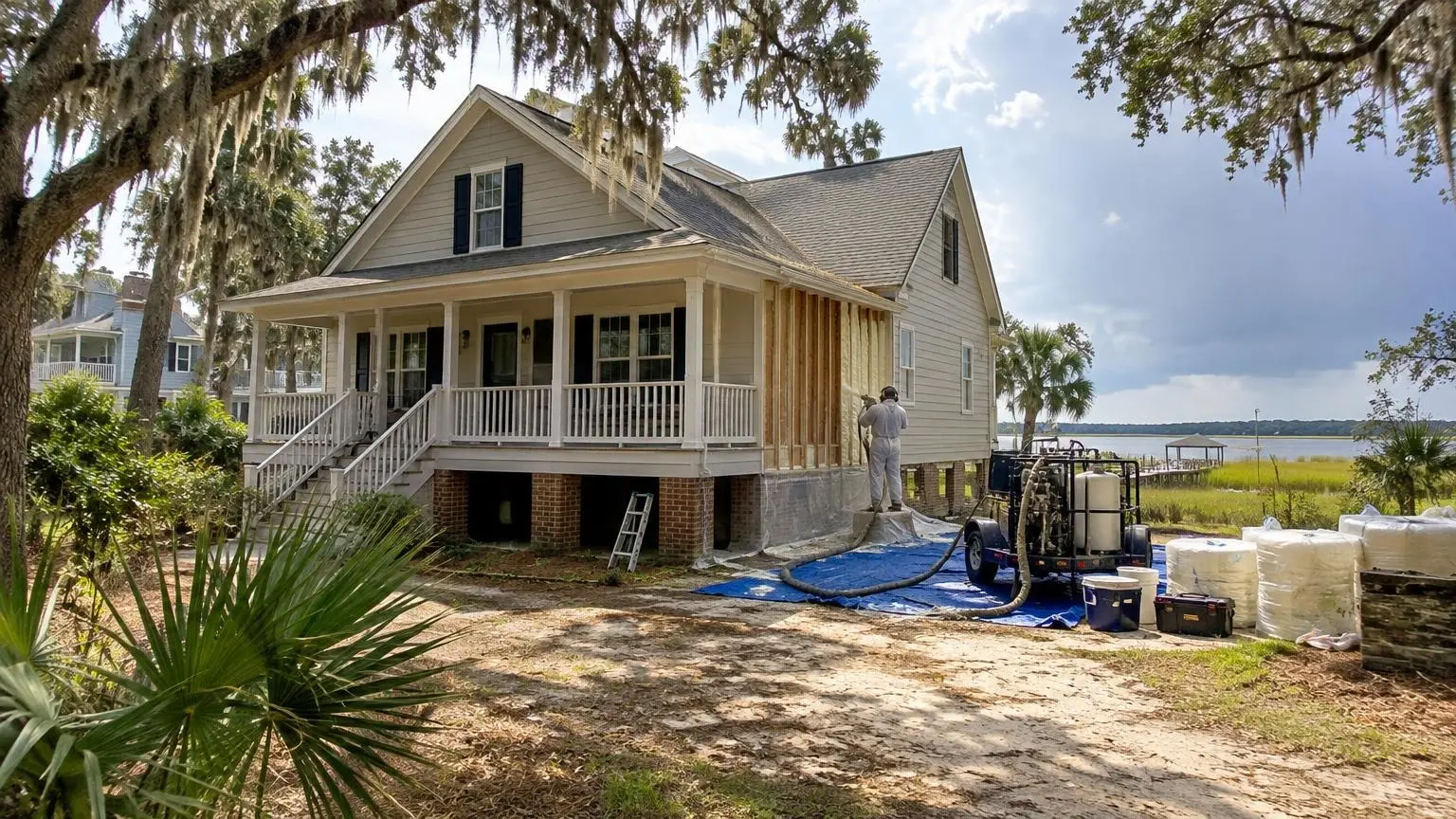
Georgia's oldest city
Spray Foam Insulation in Savannah, GA
From 1700s squares to 2020s subdivisions, every era of house has its own insulation problem.
- Free on-site estimates
- Written quotes listing foam type, thickness and R-value
- Moisture, flood-zone and termite access checked before we seal
Insulating Homes in Georgia's First City
Spray foam insulation in Savannah starts with knowing which Savannah you live in. The city was laid out in 1733 on Yamacraw Bluff above the Savannah River, and its downtown, with 22 squares, the Historic District and the Victorian District, became a National Historic Landmark District in 1966. Around that core are early 20th century neighborhoods like Ardsley Park and Thomas Square, postwar Southside streets and newer annexed subdivisions in west Chatham. Each one insulates differently.
Housing age
Savannah's median home was built in 1971. About 16.2% of homes predate 1940, another 21.3% were built in the 1940s and 1950s, and about 14.9% went up from 2010 on, based on 2019 to 2023 census estimates. About 55.9% of housing units are detached single-family homes, and 45.4% of occupied homes are owner-occupied, so rentals are a large share of what needs insulating.
Older homes
In houses from before the war, walls are often plaster over open stud bays with no insulation, attics hold a few inches of old fill, and floors sit over brick piers or vented crawl spaces. Foam in the walls usually waits for a renovation, when the bays are open. The quickest wins are sealing and topping up the attic and fixing the floor from below. Historic district rules focus on what you see from the street, but if your project touches the exterior, check with the city's preservation staff first.
Climate
Savannah is humid subtropical. July highs average about 92.3°F, August humidity averages 78.6%, and the city gets about 48 inches of rain a year, with June the wettest month at about 6.65 inches. Winters are short, with about 21 nights below freezing in an average year. Air conditioning runs for most of the year, so air leaks cost money in nearly every month.
Storms and low ground
The city sits just above sea level and has a history of flooding from heavy rain and hurricane surge. Matthew in 2016, Irma in 2017 and Debby and Helene in 2024 all hit the area. In flood-prone spots, closed-cell foam is the only spray foam FEMA rates acceptable below flood elevation, and wet crawl spaces need drainage before they are sealed.
Power company
Savannah Electric and Power merged into Georgia Power in July 2006, so most Savannah homes are Georgia Power customers and can look at its Home Energy Improvement Program for attic insulation and air sealing rebates. Get a free estimate
What to Know in Savannah
- Historic core. Downtown Savannah, with its 22 squares, the Historic District and the Victorian District, was designated a National Historic Landmark District in 1966.
- Housing age. Savannah's median home was built in 1971; about 16.2% of homes date before 1940 and about 37.5% before 1960 (2019 to 2023 census estimates).
- Summer climate. July highs average 92.3°F, August relative humidity averages 78.6%, and average yearly rain is about 48.1 inches, half of it from June through September.
- Climate zone. Chatham County is in IECC Climate Zone 2A, the hot-humid zone, where Georgia's code calls for R-38 ceilings in new homes.
- Utility. Savannah Electric merged into Georgia Power in July 2006; Georgia Power lists attic insulation and air sealing rebates.
Savannah Questions
Can you insulate a house in the Savannah Historic District?
Yes. Attic, crawl space and under-floor work happens out of sight. Projects that change the exterior need to go through the city's historic review, so check with preservation staff if your plan involves the outside.
How much does spray foam cost in Savannah?
National guides put installed spray foam at about $1.50 to $5.00 per square foot. Older homes often need some removal and sealing first. We price it in writing after a visit.
Do I need closed cell in a Savannah flood zone?
Below the flood elevation, FEMA rates closed-cell foam acceptable and open-cell unacceptable, so we use closed cell there. We ask about your flood zone before quoting.
Do Savannah rentals benefit from insulation?
Yes. With almost 55% of occupied homes rented, many landlords seal and insulate attics to cut tenant complaints about hot rooms and high bills.
Free Estimates in Savannah, GA
Savannah homeowners and landlords: request a free estimate.
Spray Foam Insulation Near Savannah
- Spray Foam Insulation in Pooler, GA
- Spray Foam Insulation in Richmond Hill, GA
- Spray Foam Insulation in Rincon, GA
- Spray Foam Insulation in Tybee Island, GA
- Spray Foam Insulation in Garden City, GA
- Spray Foam Insulation in Port Wentworth, GA
- Spray Foam Insulation in Bloomingdale, GA
- Spray Foam Insulation in Thunderbolt, GA
- Spray Foam Insulation in Wilmington Island, GA
- Spray Foam Insulation in Skidaway Island, GA
- Spray Foam Insulation in Isle of Hope, GA
- Spray Foam Insulation in Georgetown, GA
- Spray Foam Insulation in Guyton, GA
- Spray Foam Insulation in Springfield, GA