
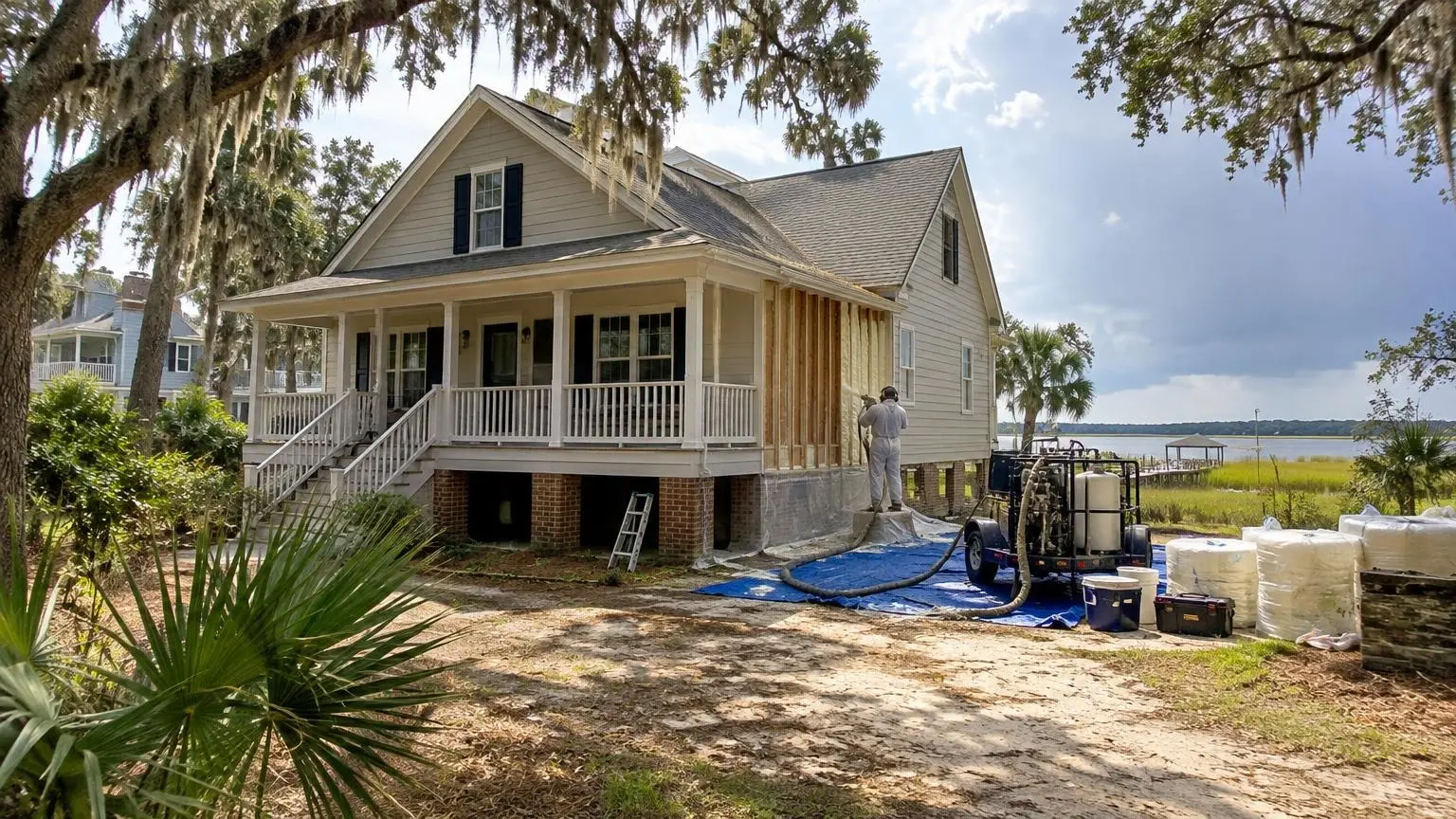
Damp crawl spaces on low ground
Crawl Space Insulation & Encapsulation in Savannah, GA
Drier floors and fewer musty smells, planned around water, termites and flood zones.
- Free on-site estimates
- Written quotes listing foam type, thickness and R-value
- Moisture, flood-zone and termite access checked before we seal
Getting Coastal Crawl Spaces Dry
Crawl space insulation and encapsulation are about controlling the air and moisture under your floor. In and around Savannah, many homes sit over vented crawl spaces on land only 10 to 25 feet above sea level, and summer air arrives with dew points near 70°F. When that air flows through foundation vents and meets a floor chilled by air conditioning, water condenses on joists, ducts and batts. The result is sagging insulation, musty smells, cupping floors and a happy home for pests.
What encapsulation means
Encapsulation closes the foundation vents, lays a heavy plastic liner over the ground and up the walls, seals the seams and openings, and then dries the space with a dehumidifier or a small amount of conditioned air. Once the crawl space is sealed, the insulation usually moves from the floor to the foundation walls and rim joists, typically closed-cell foam or rigid board.
Water comes first
A liner is not a drain. If water stands in the crawl space after storms, we check gutters, downspouts and yard grading, and recommend a sump or drainage where it is needed before we seal anything. With about half of Savannah's roughly 48 inches of yearly rain falling from June through September, wet-season water is common.
Flood zones change the plan
In flood zones, Chatham County inspects flood vents and breakaway walls on new construction, and openings that let floodwater pass usually have to stay open. Sealing those vents may not be allowed. For those homes we often recommend closed-cell foam on the underside of the floor instead, which FEMA rates as flood-resistant, and leave the crawl space vented.
Termite access
Chatham County requires proof of termite soil treatment on new homes, and termites are common across coastal Georgia. Foam or liner on foundation walls can hide termite tubes, so we leave an inspection strip at the top of the wall and coordinate with your pest company before work starts.
Floor insulation instead
Sometimes sealing is not the right fit, for example in a home with open piers. In that case, closed-cell foam under the subfloor, or new batts held up properly, is the way to go. The Department of Energy suggests R-13 for floors over unconditioned space in Zone 2. Get a free estimate
What This Covers
Crawl space work we quote and install.
Full encapsulation
Vents sealed, heavy liner on floor and walls, seams taped, space dried.
Vapor barrier only
A ground liner for crawl spaces that need moisture control but must stay vented.
Wall and rim joist foam
Closed-cell foam on block walls and band joists with a termite inspection gap.
Under-floor foam
Closed-cell foam on the subfloor where the crawl space stays vented.
Old insulation removal
Fallen, wet or pest-soiled batts bagged and hauled away.
Drying equipment
A crawl space dehumidifier or supply air, sized for the space.
Published Crawl Space Insulation & Encapsulation Costs
| Job | Range and source |
|---|---|
| Crawl space encapsulation | $3 to $10 per sq ft, $3,000 to $15,000 (HomeGuide) |
| Crawl space vapor barrier | $1,200 to $4,000 (HomeGuide) |
| Crawl space, spray foam | $2,000 to $4,000 (HomeGuide); $1,000 to $5,900 (Fixr) |
| Closed-cell on crawl space walls | $2 to $5 per sq ft (HomeGuide) |
| Rim joists, spray foam | $2,000 to $2,500 (HomeGuide) |
| Crawl space vent sealing | $150 to $450 (HomeGuide) |
National ranges from HomeGuide's 2026 spray foam and crawl space encapsulation guides and Fixr (2025). Square footage, wall height, standing water, access and debris removal set the real cost. After we crawl the space, the number on the written estimate is the price.
How It Works
1. Crawl and check
We look for water, wood damage, termite signs, duct leaks and flood vents, and note the flood zone.
2. Plan the fix
Sealed and dried, vented with a liner, or floor insulation, priced in writing.
3. Clean out
Old insulation and debris come out, and drainage problems are handled first.
4. Seal and insulate
Liner, foam or board installed, seams taped and inspection gaps left.
5. Dry and review
Drying equipment set up and humidity checked, then we walk you through it.

Crawl Space Insulation & Encapsulation Questions
Should I encapsulate my crawl space in Savannah?
Many vented crawl spaces here get damp each summer, and sealing them helps if water entry is controlled. Homes in flood zones may need to keep flood vents open, so floor foam can be the better choice there.
Do I need a dehumidifier after encapsulation?
A sealed crawl space needs some way to dry out: a dehumidifier or a small supply of conditioned air. We size it to the space and include it on the quote.
Is a vapor barrier enough?
For a vented crawl space, a ground liner cuts the moisture rising from the soil but does not stop humid air from coming in through the vents. Full encapsulation does both.
Will encapsulation block termite inspections?
Not if it is planned. We leave a strip at the top of the foundation walls for inspectors and check with your pest company first.
Crawl Space Insulation & Encapsulation Service Areas
- Spray Foam Insulation in Savannah, GA
- Spray Foam Insulation in Pooler, GA
- Spray Foam Insulation in Richmond Hill, GA
- Spray Foam Insulation in Rincon, GA
- Spray Foam Insulation in Tybee Island, GA
- Spray Foam Insulation in Garden City, GA
- Spray Foam Insulation in Port Wentworth, GA
- Spray Foam Insulation in Bloomingdale, GA
- Spray Foam Insulation in Thunderbolt, GA
- Spray Foam Insulation in Wilmington Island, GA
- Spray Foam Insulation in Skidaway Island, GA
- Spray Foam Insulation in Isle of Hope, GA
- Spray Foam Insulation in Georgetown, GA
- Spray Foam Insulation in Guyton, GA
- Spray Foam Insulation in Springfield, GA
Get a Crawl Space Insulation & Encapsulation Estimate
Book a crawl space inspection and get a written plan.